






















In addition to her son Ross, she is survived by another son, Richard, both from her marriage to Mr. Hogarth, and a grandson. She and Mr. Hogarth divorced in 1981. In 1990, she married Art Kamell, a lawyer, who died in 2010.
Her activism began in earnest during the Vietnam War, with her participation in groups like the Women’s International League for Peace and Freedom and Women’s Strike for Peace. She was arrested for the first of more than 20 times during a demonstration in Washington — a “die-in” — in which protesters laid down in front of the White House to represent the Vietnamese who were dying each day.
As the war was winding down in 1973, she and Mr. Scheiner formally started Wespac, which has embraced many causes, including ending apartheid in South Africa. Working with two Westchester County legislators, Wespac helped persuade the county to stop investing in banks that did business with South Africa.
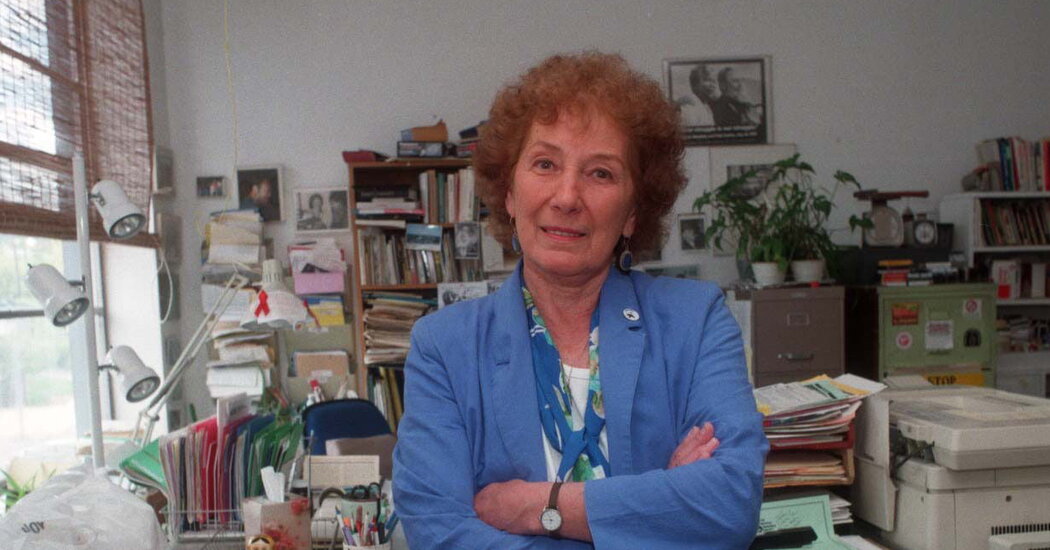
Ms. Hogarth was called “The Conscience of White Plains” by The Daily News in 1979 and, in 1983, the “pre-eminent dissenter in Westchester,” by Suburbia Today, the Sunday supplement of Gannett’s Westchester Rockland Newspapers.
“Every issue that needed a home, that needed a place to hold meetings, happened at Wespac,” said Al Giordano, who joined the organization in the 1970s as a teenager. “When the small Black community in Westchester was organizing against landlords, or against police brutality, Connie opened the door to them.”
She retired as Wespac’s executive director in 1996 after 23 years. Two years later, the Connie Hogarth Center for Social Action opened at Manhattanville College in Purchase, N.Y., where she helped teach students become effective social activists. She was also involved with the organizations Climate Crisis Coalition, the New York Civil Liberties Union and the environmental group Hudson River Sloop Clearwater, as well as local Democratic politics.
Nada Khader, the executive director of Wespac (now the Wespac Foundation) for the past 21 years, said in a phone interview that Ms. Hogarth had remained an important adviser to the organization, adding, “She showed me how to be a more impactful organizer for progressive social change while exuding a gentle, soft spirit.”