

















Now that the clamor of humans had arrived, the muteness of the earth became more significant. It needed to be journeyed to, listened out for, meditated on like a kind of god. The story of marble, which was a story of the violation and the worship of this entity, earth, seemed more and more to represent the search for a greater — possibly a profane — intimacy with it, a desire to be subsumed into its immortality that was also the desire to possess it. In the museums in Athens the fruits of this quest were preserved in countless cavernous galleries, the faces and forms of antiquity that in their extraordinary plenitude constituted a statement about the desire of man to make his mark. To create a human face out of marble is not just to immortalize it; it is to demonstrate an ambiguous need for submission to this god at the same time as attempting to gain mastery over it. For the earth is our only authority.
Is it true that the act of representation is also by necessity an act of destruction, because it is inseparable from human autonomy? That in seeing, a human robs that which he sees by the mere processes of perception? I had regarded writing not as destructive but as useful, helpful even, a kind of path-finding, yet perhaps these tracks I left everywhere were in their way an invitation to some future blight, just as in landscape the early ways and paths had eventually become busy roads and roundabouts and motorways.
In the neglected garden I sat and read about works of fascist architecture: the Palace of the Parliament in Bucharest that is made from over a million cubic meters of marble; the Foro Italico in Rome, where football fans still come and go beneath Mussolini’s marble porticoes, past his mock-classical statues of athletes and the giant marble obelisk he erected in honor of himself. The Palace of the Parliament is so heavy that it sinks six millimeters into the earth every year. It was built by enforced labor, involved the displacement of 40,000 of the city’s citizens, and a large proportion of its thousand-plus rooms were never completed. It might be said that while the artist is often weaker than the things he creates, the dictator struggles to make something that will outlast him. The moral problem of marble seemed to be encapsulated in the survival of these buildings. I read about an artist in Athens who makes marble sculptures of sagging bin bags, broken cardboard boxes, piles of rubbish.
One night, sitting on the terrace of a restaurant on the hillside, an unearthly sunset began to enact itself in front of us over the water. The sky turned almost green, turned bilious and swollen, and then came a series of what were almost convulsions, a sort of protracted fit, and a flood of preternaturally colored phantomlike shapes began to pour out of the horizon, as though the sinking sun had burst. The sky was like something mad that had got free: It seemed to come toward us in a frenzy, to lift the sea out of its bed and devour the distant islands, until the whole bay was embroiled in a silent commotion that suddenly erupted into an obscure kind of ecstasy. It was disturbing to see something so nakedly expressive, so intimate, so unknown. The restaurant was busy, but even the waiters stopped what they were doing and stood there looking.
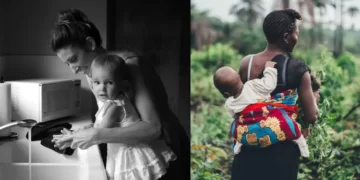
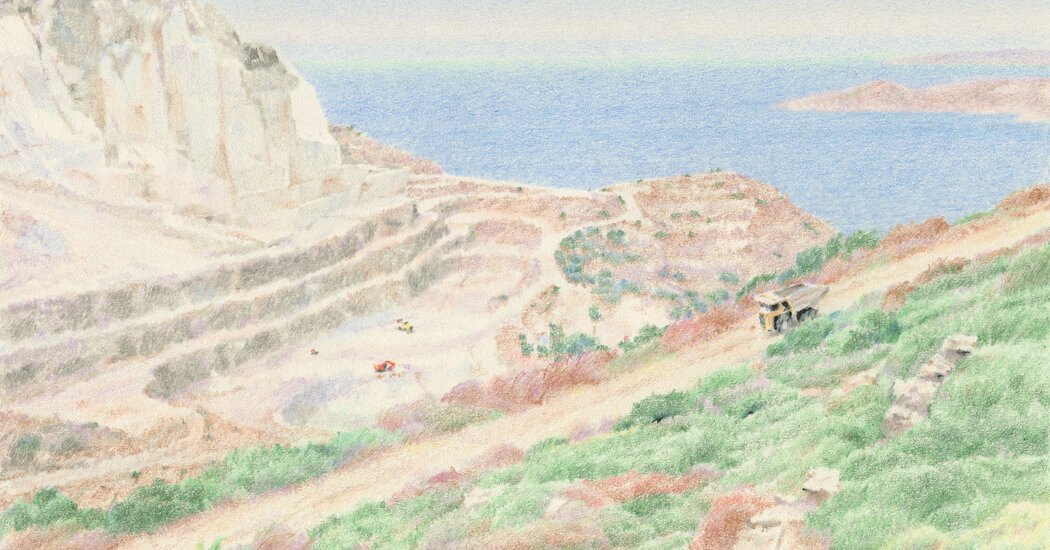
We left the island for a few days to go to another island, where I had been invited to visit a marble quarry with a centuries-long history, and this second transition within the first shed on us a strange light of anonymity. Once, when my daughter was a baby, I had to leave her for a few days to go to America, where I had been invited to give a talk. The anguish of that journey, which became clear to me the moment it began, and of the time that followed it, is still there, a kind of scar on my memory. In that period every step I took away from her in time and space was a transgression. During those days it became almost unbearable to be alive. Yet there has never been any recognition or explanation of that torment. It was simply a consequence of being a working mother; the agony was something no one else shared or could even see. The cataclysms of motherhood amount, in the end, to so many footprints in the sand. History cannot be made of them: They are a phantom that haunts the agreed-on structures of the real.
I remembered, on this journey to the second island, that long un-history, in which every future moment appeared to be a threshold that contained the possibility of stepping away from my ghost life and back into the life I knew. But in fact I never found that threshold; I stayed lost in the dissimulations of motherhood, whose privatized nature meant that no honest or legitimate relation to reality could ever again be established. Having children remained in the category of personal choice, where concepts of justice could not reach it. I saw how other women took every personal pleasure they could in their children, understanding that this was to be their sole reward. My scruples would not allow me to take pleasure in that way: My chief satisfaction lay in the idea that my children could be free of me, free as I had never been. But perhaps it was merely that I had not sacrificed enough and that the work that took me away from my daughter — agonizing though it had been — was in fact a form of selfishness that disqualified me from the secret recompenses of motherhood.
The boat drove for hours across the bright water, sometimes passing other islands whose little white towns and villages scrambled neatly over the hillsides, and from that distance the breach between humans and the earth seemed lessened, seemed to arrive at a remote kind of harmony, or the illusion of it — it didn’t seem to matter which. There in the sea, with the links to land loosened or suspended, the voidlike space of transition appeared to me as a location in itself, somewhere I had been many times but never stopped: I knew by now the feeling here of lightness that was also loss, and had learned that the lost things could not be recovered in this nonplace, that some expense of identity was incurred here that perhaps made it dangerous to visit too often.