
























Audrey Dellas
Orlando, Fla.
To the Editor:
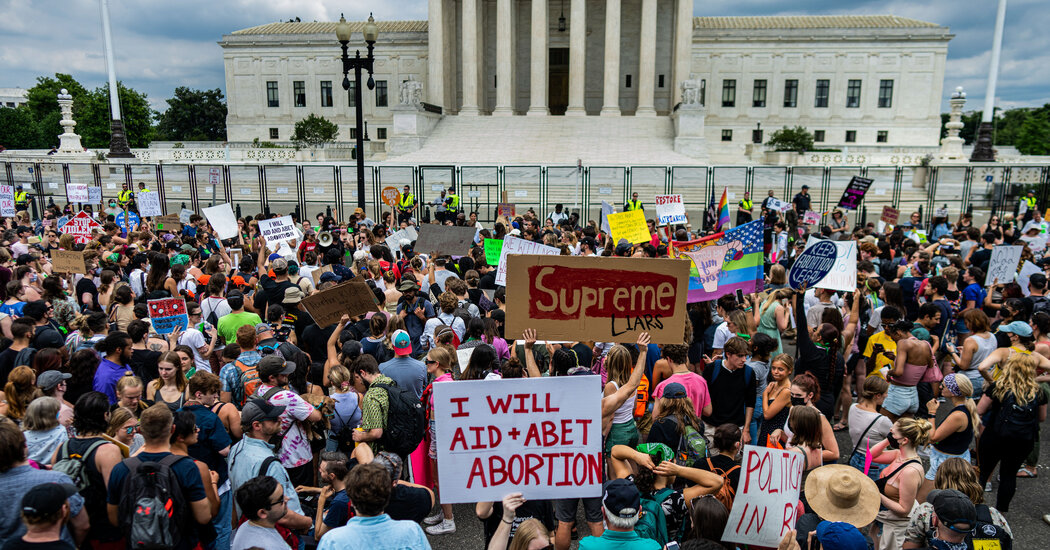
Against the backdrop of Friday’s draconian Supreme Court decision to overturn the hard-earned right for women to control their own bodies, there is a sorely overlooked factor — the other half of the pregnancy, the father. If every pregnancy also required a paternity test, and the male progenitor named, how different the law would become.
Imagine if 50 percent of the pregnancy and birthing medical bills were mandated to the male. Imagine that the same would be true for child care costs. Let’s stop the battle of when life begins and move it to when does responsibility begin? If responsibility begins at the point of conception for the males involved in every pregnancy, let’s see how quickly women’s health decisions are decriminalized and abortion rights laws remain.
Rosanne Somerson
Westport, Mass.
To the Editor:
With the Supreme Court’s precedent-shattering decisions on guns and abortion this week, we Americans would do well to take a moment and think about all the babies who might otherwise not have been born who will now grow up to be shot in adolescence.
David D. Turner
Clifton, N.J.
To the Editor:
Roe has been overturned. What was an abortion like pre-Roe?
I had a scary abortion in the 1960s when I was in college. On my own, I arranged a back-alley abortion in New York City. Then the brother of a friend, a seminary student, urged me to tell my parents. I did. My father took me to Copenhagen to have a legal abortion in a hospital. But once there, the hospital said I couldn’t have an abortion because I wasn’t a citizen. So I ended up having a back-alley abortion after all.
After getting back to college, I got a fever, went to the hospital and had a dilation and curettage. The doctor said I likely would have died had I waited until the next day. The college became aware that I had had an abortion and suspended me for a year. I went to Paris for a “year abroad” as a cover. I didn’t tell anyone. Not even my friends.
Sara Cummins
Belmont, Mass.
To the Editor:
Precedent guides lower and Supreme Court rulings. It places importance on the consistency of legal interpretation. While we may not like a decision, precedent gives both plaintiff and defendant certainty from their day of justice. As Justice Clarence Thomas says, people must “live with outcomes we don’t agree with.” But if the court won’t follow these words, why should the citizens?