
























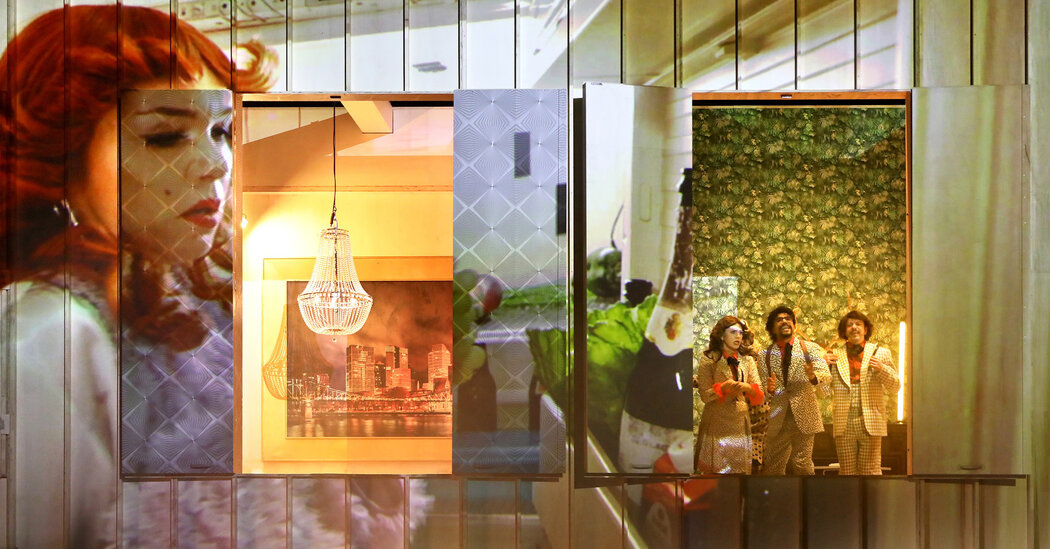
Many of the emerging female directors in Germany seem more committed to work that explicitly engages with feminist and post-feminist topics than directors of Bauer’s generation, who were pioneers in a male-dominated landscape where professional success often meant becoming one of the guys. Along with addressing issues of women’s representation, history and psychology, some of these younger directors — including artists from all over Europe, as well as the United States and Israel — are creating exciting stage aesthetics to address those themes.
On Schauspiel Frankfurt’s smaller stage, the Kammerspiele, the Austrian-Bulgarian director Christina Tscharyiski, 33, has bravely taken a stab at one of the strangest, most obscure and most difficult-to-perform German plays of the 20th century: “I and I” (“Ichundich”) by Else Lasker-Schüler.
That German-Jewish Expressionist poet and artist, who fled the Nazis in 1933, called her sprawling work, in six acts and an epilogue, a “hell play.” Composed in 1940 and 1941, “I and I” is an infernal romp that features characters from Goethe’s “Faust” and real-life personalities, including Lasker-Schüler herself and much of the Nazi high command. The unlikely group meets up in a version of hell somewhere in Jerusalem, which is where the author lived in unhappy exile until her death in 1945.
The play was long ignored as an unperformable oddity: It made it to the stage for the first time only in 1979. In the barely four decades since, productions have been exceedingly rare. Tscharyiski’s take on “I and I,” stylishly designed by Verena Dengler and Dominique Wiesbauer, resembles a kind of Dadaesque haunted house where characters in Hasidic robes, medieval garb and Nazi uniforms wander a stage strewn with ash.
Unfortunately, the production’s charms are largely visual, and the shortened performing version of the text fails to cohere in a compelling thematic, narrative or poetic way. Despite inspired performances by Friederike Ott as the poet, Lasker-Schüler’s alter ego, and Florian Mania and Tanja Merlin Graf as a pair of rival Mephistos, the demon who bargains for Faust’s soul, the production seems both overstuffed and underdeveloped, and much longer than its 75 minutes.
Yet despite the production’s limitations, it feels momentous that this complex work is being reconsidered 80 years after it was written. And it’s heartening to know that a director as prodigiously talented as Tscharyiski can be enlisted to aid in our rediscovery of a key 20th-century artist whose theater works are too little known.
Der diskrete Charme der Bourgeoisie. Directed by Claudia Bauer. Schauspiel Frankfurt, through May 1.
Ichundich. Directed by Christina Tscharyiski. Schauspiel Frankfurt, through April 17.