
























“What will we do when Roe falls? In many ways, living in Texas under this law, it already has.”
—Rosann Mariappuram, executive director of Jane’s Due Process abortion fund
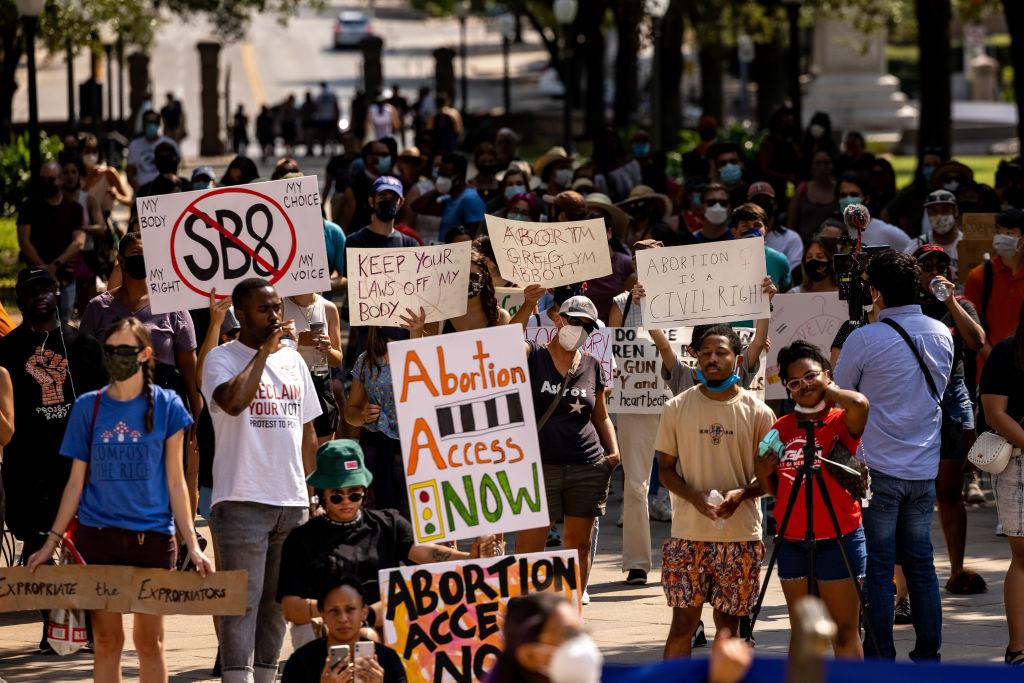
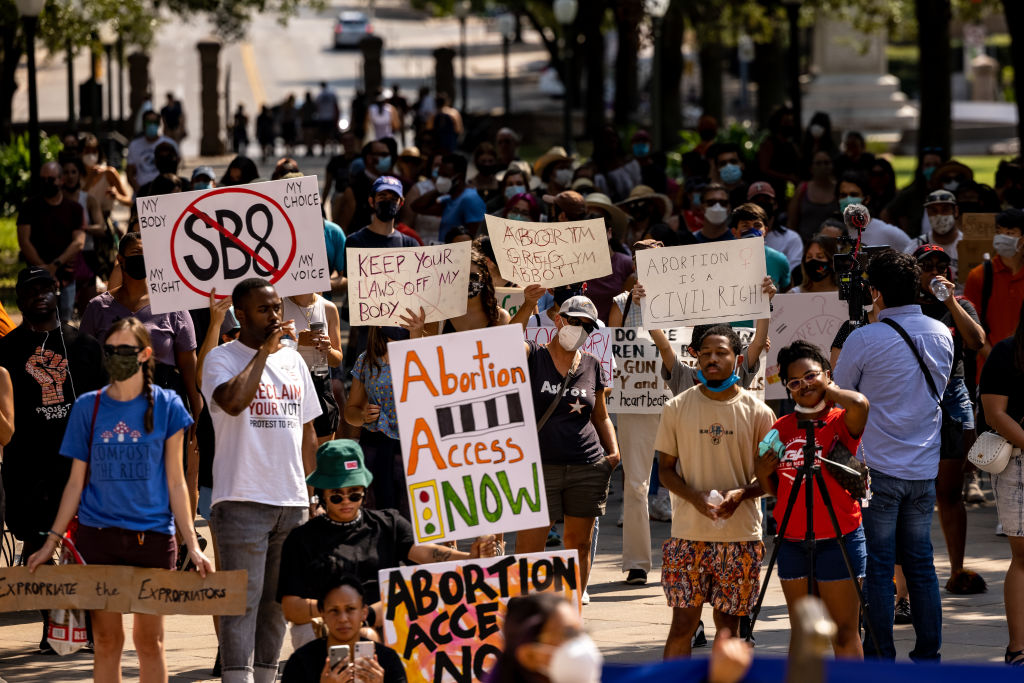
It’s been six long months since Texas’s six-week abortion ban, Senate Bill 8, took effect. The devastating impact the law has had around the state, and the reverberations felt around the country, cannot be overstated.
- The average round trip to obtain an abortion outside of Texas has jumped from 807 to 1,160 miles since S.B. 8 took effect, according to Fund Texas Choice, the largest practical abortion support fund in Texas. Their call volume increased fivefold, and the vast majority (around 73 percent) of these callers are people of color.
- Clinics in surrounding states like Oklahoma and Louisiana are now overloaded with Texas patients. (A copycat abortion ban is working through the Oklahoma state legislature too, so this option may not be available for Texas abortion seekers in the future.)
- Daily, clinic administrators on the ground are forced to turn desperate people in tears away.
“The staff is exhausted. The phone calls are nonstop,” said Kathaleen Pittman, clinic administrator at Hope Medical Group for Women in Louisiana, who estimates more than 60 percent of patients at Hope Medical are from Texas. “The amount of control the state of Texas has over these women is horrific.”
Admittedly “every abortion ban creates a human rights tragedy,” said Amy Hagstrom Miller, president and CEO of Whole Woman’s Health, which operates four clinics in Texas. But with S.B. 8, Texas achieved something no other state has: the banning of abortion at just six weeks gestation—making it the most extreme abortion ban to take effect in the U.S. since abortion was legalized in 1973.
Marc Hearron, senior counsel at the Center for Reproductive Rights (CRR), calls the continuation of S.B. 8 “a grave warning for the rest of the country” and “a preview of what will happen on a much larger scale if Roe falls.”
And fall it may—as soon as this June, when the Court is expected to issue its ruling in Dobbs v. Jackson Women’s Health Organization. The case requires the justices to consider whether all pre-viability prohibitions on abortion are unconstitutional and marks the first abortion case in front of the Court that could overturn Roe v. Wade. Regardless of what the Supreme Court says outwardly in its decision about the fate of Roe, if it allows the 15-week ban out of Mississippi to take effect, Roe—which currently allows abortions up to 24 weeks—is effectively over.
On behalf of CRR, Hearron argued in front of the Texas Supreme Court on Thursday in Whole Woman’s Health v. Jackson, one of the legal challenges to Texas’s ban on abortion beginning at approximately six weeks of pregnancy—but to be clear, the Texas court’s ruling will have no bearing on whether or not S.B. 8 is the law of the land. It won’t stop the bounty hunter scheme, or restore abortion access for Texans who need the healthcare currently deemed a constitutional right.
“At this point, the best outcome we can get in this case would be a ruling blocking the state licensing officials from disciplining doctors, nurses, pharmacists and facilities, or revoking those facilities’ licenses, for violating S.B. 8,” said Hearron on a Thursday press call after oral arguments. “The questions before the court this morning were highly technical, and the justices gave no clear indication of how they will rule,” Hearron later told Ms. in an email.
A district court in Austin heard a challenge to the law in December—but according to Stephen Vladeck, a law professor at UT Austin, until the Texas Supreme Court issues a ruling on Thursday’s case, the district court can’t do anything to block S.B. 8 either.
“Even as [state court litigation] moves ahead slowly, there are very few mechanisms for those cases to actually produce any ruling that would block S.B. 8,” said Vladeck. “And so, we really are in this Kafka-esque purgatory where the law is in effect even though the law on the books would suggest it is pretty blatantly unconstitutional.”
What about the highest law in the land? The conservative majority on the Supreme Court has repeatedly decided to allow the law to remain in effect—despite myriad lawsuits from plaintiffs ranging from the Department of Justice to on-the-ground abortion providers, and its direct opposition to the 1973 decision in Roe, as well as the 1992 decision in Planned Parenthood v. Casey, which reaffirmed Roe.
“The Supreme Court has repeatedly refused to step in and protect [Texans], … greenlit this laws’s unprecedented vigilante scheme, and essentially said federal courts are powerless to stop it,” said Hearron.
A Gallup poll from September shows Supreme Court approval at 40 percent—the lowest number recorded since the poll first started tracking this question in August of 2000.
The Supreme Court “only has its reputation and institutional legitimacy,” wrote Madiba K. Dennie, a legal scholar and counsel at the Brennan Center for Justice. “It stands to lose both when it behaves in profoundly disreputable and illegitimate ways.”
Historic Senate Vote Asks Lawmakers To Consider Federal Abortion Protections
2021 was the worst year for abortion restrictions since Roe v. Wade, which brings a new urgency to the passage of Women’s Health Protection Act (WHPA), which codifies abortion rights into law. The U.S. House of Representatives passed WHPA in September of last year in a narrow 218–211 vote, with all Republicans and Democratic Rep. Henry Cuellar of Texas voting against it.
The U.S. Senate will conduct a historic vote Monday, Feb. 28, when it too considers WHPA—“because a woman’s right to choose is a fundamental right,” said Senate Majority Leader Chuck Schumer (D-N.Y.).

“People are counting on the Senate to do what the Supreme Court will not,” said Nancy Northup, CEO of the CRR. “The hardship and chaos in Texas right now is coming to other states soon, unless the right to abortion is protected through federal legislation.”
“We need to trust women to make important decisions about their own reproductive destinies,” said House co-sponsor Rep. Lois Frankel (D-Fla.). “The Women’s Health Protection Act will take the power to make these deeply personal medical decisions out of governors’ mansions and state legislatures and put it back where it belongs: in the hands of patients and persons they trust.”
A CRR poll conducted by Hart Research shows 61 percent of U.S. voters support WHPA. If passed, WHPA would supersede state-level restrictions on abortion—like S.B. 8 or the many lookalike bills making their way through state legislatures across the U.S—but it faces an uphill battle in the Senate unless Democrats move to eliminate or reform the filibuster.
Majority of Americans Approve of Roe and Disapprove of Texas Abortion Law
Sixty percent of Americans believe the U.S. Supreme Court should uphold its 1973 decision in Roe v. Wade, which established the constitutional right to abortion, according to a recent Washington Post-ABC News poll. Just 27 percent believe it should be overturned.
About the same percentage—58 percent—oppose legislation like Texas Senate Bill 8, which makes it more difficult to obtain or perform an abortion.
When asked specifically about the Texas law, which bans abortions after six weeks gestation and is enforced by private vigilantes, an even larger percentage—65 percent—think the Supreme Court should reject the law. A whopping 75 percent of Americans think the decision whether or not a person should have an abortion “should be left to the woman and her doctor.”
Sign and share Ms.’s relaunched “We Have Had Abortions” petition—whether you yourself have had an abortion, or simply stand in solidarity with those who have—to let the Supreme Court, Congress and the White House know: We will not give up the right to safe, legal, accessible abortion.
Carrie Baker assisted with this reporting.
Up next: