





















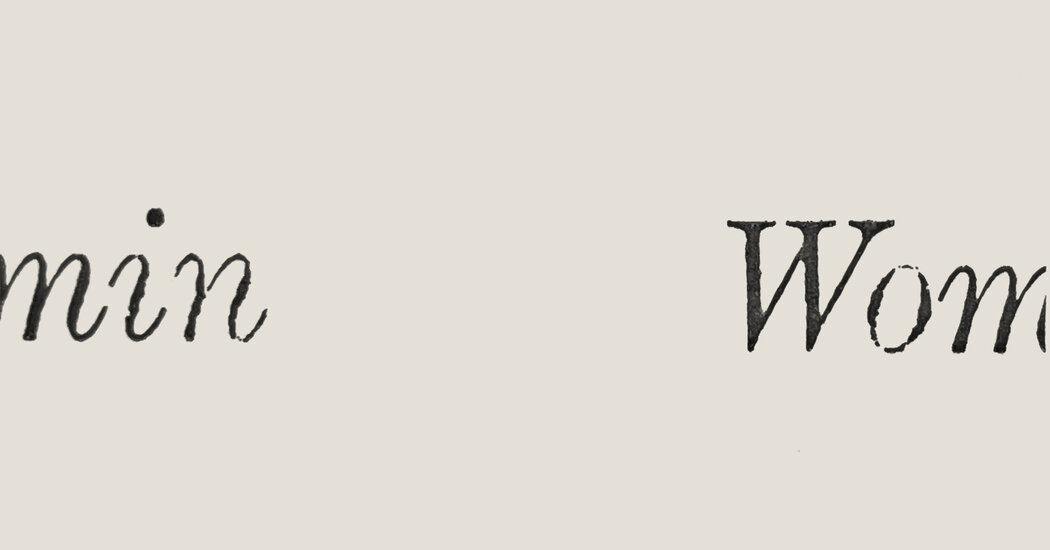
When you pronounce a vowel after a “w,” often the vowel becomes rounder, because your lips are still kissed-up, if you will, to make that “w.” The first vowel in the word for this reason became a rounder sound, which is today that first vowel in “woman.” In the plural, though, that vowel stayed the way it was, and brought about a new situation where “wuh-mun” meant singular and “wih-min” meant plural.
“Girl” has an even odder history: In Old English, at first, a baby was a child, but older children could be called two things. One was “bairn,” which was not yet restricted to the primarily Scottish use of the word, which still refers to children more generally. The other was “girl,” which, believe it or not, didn’t refer only to female children. In “The Canterbury Tales” prologue, Chaucer wrote that the Summoner had “the yonge girles of the diocise” within his sphere of influence. It would be senseless in that context for the reference to be to females only, as opposed to young people in general.
In Middle English, male children were “knave” girls while female children were “gay” girls. Only in Modern English did “girl” come to refer only to female children. Why this happened isn’t certain, but it’s not uncommon for words to specialize over time in that way: “meat” originally referred to all food or sustenance, kind of like the phrase “daily bread”; “apple” to fruits generally; and “queen” began as a word for “woman” in general, and only later specialized royally. However, which words go in which directions can be quite fortuitous, and some words acquire wider, rather than narrower meanings. “Dog” first referred to certain larger, more powerful dogs, then came to mean all dogs. “Child” came to mean all pre-adults rather than just the littlest ones. As we moved from Middle English to Modern English, even “child” could take on a female meaning in a certain context. A line in Shakespeare’s “The Winter’s Tale” asks, “A boy or a child, I wonder?” And one might suppose that this suggests that a girl is somehow less distinctive than a boy, a mere generic “child.” But it’s possible this actually traces back to when “child” referred specifically to female children.
Other words referring to women have humble histories that changing sounds have concealed, probably for the better. “Lady” results when you say the Old English term for “bread maid” quickly and repeatedly for centuries — specifically, “hlaef-dige” where “hlaef” was what we now know as “loaf” while “dige” doesn’t really translate in our language today. Just as the “f” dropped out of “wifman” to become “wimmin,” the “f” dropped out of “hlaefdige,” and as both the start and the finish of the word frayed, the result was what we pronounce as “lay-dee.”