





Tuesday, April 21, 2026
Women India
Advertisement
  • Home
  • About us
  • News
    • Lifestyle
      • Home & Decor
      • Travel & Leisure
      • Fashion & Style
      • Beauty & Skincare
      • Food & Recipes
    • Health & Wellness
      • Mental Health
      • Nutrition
      • Physical Fitness
      • Women’s Health
      • Yoga & Meditation
    • Career & Business
      • Career Advice
      • Investment
      • Leadership & Mentorship
      • Work-Life Balance
      • Women Entrepreneurs
      • Inspiration & Stories
    • Inspiration & Stories
      • Women Achievers
      • Change Makers
      • Grassroots Heroines
      • Interviews & Profiles
      • Celebrity Stories
    • Culture & Society
      • Women in Indian Culture
      • Social Change
      • Festivals & Traditions
      • Regional Spotlights
      • Religion & Spirituality
    • Events & Community
      • Women-Centric Events
      • Webinars & Workshops
      • Community Voices
      • Local Groups & Forums
      • Awards & Recognitions
  • Magazine
  • Women’s Rights
    Women officers to help PM unfurl flag on I-Day

    Women officers to help PM unfurl flag on I-Day

    App Helps Identify Autistic Children in India.

    App Helps Identify Autistic Children in India

    Salmon Arm’s Mamas for Mamas took home the bulk of the money donated at Shuswap Women Who Wine’s latest Community Giving Event held at R.J. Haney Heritage Village and Museum on Saturday, June 18, 2023

    Salmon Arm’s Mamas for Mamas the toast of latest Shuswap Women Who Wine event

    Tech can help remove biases against women at the hiring level, while hybrid work gives women the highest flexibility, say tech leaders Sindhu Gangadharan and Irina Ghose.

    Tech & hybrid the tools to plug leak in women talent pipeline, says women panel at BT Tech Today Congress

    Chandrika Majhi holds her baby son outside her house in Gadadi, India.

    Women’s rights at stake as India’s population surpasses China’s

    India can move forward only by raising the levels of respect for women: PM Modi

    India can move forward only by raising the levels of respect for women: PM Modi

    Meet Nilima Motapatri, one of India’s richest women, not from IIT, IIM, her business is…

    Meet Nilima Motapatri, one of India’s richest women, not from IIT, IIM, her business is…

    Mothers are the primary influencers of children since the time they are born. Having a working mother can mould the psyche of children and make them more attuned to gender balance.

    7 ways working mothers influence children that will change your view about ‘letting’ women work

    Five Women Officers (WOs) being commissioned into the Regiment of Artillery are being provided exactly the same opportunities and challenges as their male counterparts

    First Batch of Women Officers Commissioned into the Regiment of Artillery of the Indian Army

  • Entrepreneurs
    Jyoti Ratre, 55, Becomes Oldest Indian Woman to Conquer Mount Everest: Who is she?

    Jyoti Ratre, 55, Becomes Oldest Indian Woman to Conquer Mount Everest: Who is she?

    Meet Amita Goyal Mumbai based Business women Entrepreneur & founder of Glasba Services , read her Success Story here

    Meet Amita Goyal Mumbai based Business women Entrepreneur & founder of Glasba Services , read her Success Story here

    From Isha Ambani to Namita Thapar: Lavish homes of India's women entrepreneurs

    From Isha Ambani to Namita Thapar: Lavish homes of India’s women entrepreneurs

    Trailblazing Entrepreneur Recognized for Her Achievements

    Trailblazing Entrepreneur Recognized for Her Achievements

    Goldman Sachs' education programme helped 2,400 Indian women entrepreneurs generate 28,000 cr revenue

    Goldman Sachs’ education programme helped 2,400 Indian women entrepreneurs generate 28,000 cr revenue

    Entrepreneur Zafreen Khan and her journey to success

    Entrepreneur Zafreen Khan and her journey to success

    Saral Creating An Ecosystem To Empower Women

    Saral Creating An Ecosystem To Empower Women

    How scrap paper helped Delhi’s Poonam Gupta set up a business empire in Scotland

    How scrap paper helped Delhi’s Poonam Gupta set up a business empire in Scotland

    The Future of Female Entrepreneurs in Beauty Shines Bright—shark Tank India Has Proof

    The Future of Female Entrepreneurs in Beauty Shines Bright—shark Tank India Has Proof

  • Women and Girls
    Bangladeshi Women, Girls, Minorities Face Rising Violence

    Bangladeshi Women, Girls, Minorities Face Rising Violence

    Empowering girls through STEM education

    Empowering girls through STEM education

    The women of Kanal Tola village are forced to live in this hut which has no door and no amenities.

    Banished for Bleeding: Tribal Indian Women Get Better Period Huts

    Largest Unit of Indian Women Peacekeepers in Sudan Conflict Zone

    Largest Unit of Indian Women Peacekeepers in Sudan Conflict Zone

    AI’s Captain Zoya Becomes The 1st Indian To Enter the SFO Aviation Museum

    AI’s Captain Zoya Becomes The 1st Indian To Enter the SFO Aviation Museum

    The stamp issued in 1998 in honour of Savitribai Phule

    On Savitribai Phule Jayanti, Know Why Every Literate Indian Woman is Indebted to Her

    UNDP Launches Ambitious Plan to Speed Up Progress on Gender Equality and Women’s Empowerment

    UNDP Launches Ambitious Plan to Speed Up Progress on Gender Equality and Women’s Empowerment

    Achieving Gender Equality in India: What Works, and What Doesn’t

    Achieving Gender Equality in India: What Works, and What Doesn’t

    Making Science An Inclusive Space For Women And Girls

    Making Science An Inclusive Space For Women And Girls

  • Exhibitions
  • Contact Us
  • Team
No Result
View All Result
  • Home
  • About us
  • News
    • Lifestyle
      • Home & Decor
      • Travel & Leisure
      • Fashion & Style
      • Beauty & Skincare
      • Food & Recipes
    • Health & Wellness
      • Mental Health
      • Nutrition
      • Physical Fitness
      • Women’s Health
      • Yoga & Meditation
    • Career & Business
      • Career Advice
      • Investment
      • Leadership & Mentorship
      • Work-Life Balance
      • Women Entrepreneurs
      • Inspiration & Stories
    • Inspiration & Stories
      • Women Achievers
      • Change Makers
      • Grassroots Heroines
      • Interviews & Profiles
      • Celebrity Stories
    • Culture & Society
      • Women in Indian Culture
      • Social Change
      • Festivals & Traditions
      • Regional Spotlights
      • Religion & Spirituality
    • Events & Community
      • Women-Centric Events
      • Webinars & Workshops
      • Community Voices
      • Local Groups & Forums
      • Awards & Recognitions
  • Magazine
  • Women’s Rights
    Women officers to help PM unfurl flag on I-Day

    Women officers to help PM unfurl flag on I-Day

    App Helps Identify Autistic Children in India.

    App Helps Identify Autistic Children in India

    Salmon Arm’s Mamas for Mamas took home the bulk of the money donated at Shuswap Women Who Wine’s latest Community Giving Event held at R.J. Haney Heritage Village and Museum on Saturday, June 18, 2023

    Salmon Arm’s Mamas for Mamas the toast of latest Shuswap Women Who Wine event

    Tech can help remove biases against women at the hiring level, while hybrid work gives women the highest flexibility, say tech leaders Sindhu Gangadharan and Irina Ghose.

    Tech & hybrid the tools to plug leak in women talent pipeline, says women panel at BT Tech Today Congress

    Chandrika Majhi holds her baby son outside her house in Gadadi, India.

    Women’s rights at stake as India’s population surpasses China’s

    India can move forward only by raising the levels of respect for women: PM Modi

    India can move forward only by raising the levels of respect for women: PM Modi

    Meet Nilima Motapatri, one of India’s richest women, not from IIT, IIM, her business is…

    Meet Nilima Motapatri, one of India’s richest women, not from IIT, IIM, her business is…

    Mothers are the primary influencers of children since the time they are born. Having a working mother can mould the psyche of children and make them more attuned to gender balance.

    7 ways working mothers influence children that will change your view about ‘letting’ women work

    Five Women Officers (WOs) being commissioned into the Regiment of Artillery are being provided exactly the same opportunities and challenges as their male counterparts

    First Batch of Women Officers Commissioned into the Regiment of Artillery of the Indian Army

  • Entrepreneurs
    Jyoti Ratre, 55, Becomes Oldest Indian Woman to Conquer Mount Everest: Who is she?

    Jyoti Ratre, 55, Becomes Oldest Indian Woman to Conquer Mount Everest: Who is she?

    Meet Amita Goyal Mumbai based Business women Entrepreneur & founder of Glasba Services , read her Success Story here

    Meet Amita Goyal Mumbai based Business women Entrepreneur & founder of Glasba Services , read her Success Story here

    From Isha Ambani to Namita Thapar: Lavish homes of India's women entrepreneurs

    From Isha Ambani to Namita Thapar: Lavish homes of India’s women entrepreneurs

    Trailblazing Entrepreneur Recognized for Her Achievements

    Trailblazing Entrepreneur Recognized for Her Achievements

    Goldman Sachs' education programme helped 2,400 Indian women entrepreneurs generate 28,000 cr revenue

    Goldman Sachs’ education programme helped 2,400 Indian women entrepreneurs generate 28,000 cr revenue

    Entrepreneur Zafreen Khan and her journey to success

    Entrepreneur Zafreen Khan and her journey to success

    Saral Creating An Ecosystem To Empower Women

    Saral Creating An Ecosystem To Empower Women

    How scrap paper helped Delhi’s Poonam Gupta set up a business empire in Scotland

    How scrap paper helped Delhi’s Poonam Gupta set up a business empire in Scotland

    The Future of Female Entrepreneurs in Beauty Shines Bright—shark Tank India Has Proof

    The Future of Female Entrepreneurs in Beauty Shines Bright—shark Tank India Has Proof

  • Women and Girls
    Bangladeshi Women, Girls, Minorities Face Rising Violence

    Bangladeshi Women, Girls, Minorities Face Rising Violence

    Empowering girls through STEM education

    Empowering girls through STEM education

    The women of Kanal Tola village are forced to live in this hut which has no door and no amenities.

    Banished for Bleeding: Tribal Indian Women Get Better Period Huts

    Largest Unit of Indian Women Peacekeepers in Sudan Conflict Zone

    Largest Unit of Indian Women Peacekeepers in Sudan Conflict Zone

    AI’s Captain Zoya Becomes The 1st Indian To Enter the SFO Aviation Museum

    AI’s Captain Zoya Becomes The 1st Indian To Enter the SFO Aviation Museum

    The stamp issued in 1998 in honour of Savitribai Phule

    On Savitribai Phule Jayanti, Know Why Every Literate Indian Woman is Indebted to Her

    UNDP Launches Ambitious Plan to Speed Up Progress on Gender Equality and Women’s Empowerment

    UNDP Launches Ambitious Plan to Speed Up Progress on Gender Equality and Women’s Empowerment

    Achieving Gender Equality in India: What Works, and What Doesn’t

    Achieving Gender Equality in India: What Works, and What Doesn’t

    Making Science An Inclusive Space For Women And Girls

    Making Science An Inclusive Space For Women And Girls

  • Exhibitions
  • Contact Us
  • Team
No Result
View All Result
Women India
No Result
View All Result
Home Featured

A Woman Alone in Oman: Three Weeks Along the Arabian Coast

Anagha Salvi by Anagha Salvi
May 9, 2022
in Featured, Women and Girls
A Woman Alone in Oman: Three Weeks Along the Arabian Coast
Share on FacebookShare on Twitter
Post Views: 94


I could barely tell where the salt ended and the sky began.

I was on my way to Masirah, Oman’s largest island, when the surrounding terrain turned into a massive salt flat. At its edge, near the road, two Bangladeshi workers were up to their ankles in the mixture of liquid and minerals, pushing the salt flakes into pyramid-shaped piles. I, too, waded in, the horizon blurred by an orange-pink haze.

Finally I reached the ferry and, after more than an hour at sea, arrived at Masirah. I began driving down the west coast of the bowtie-shaped island, hoping to make it to its southern point by sundown, a distance of some 40 miles. The farther I got from the port, the fewer people I saw — until, pulling onto the sand of Bu Rasas Beach, there was no one. With the trunk of my S.U.V. open to the sea, emitting the only light for miles, I could hear the small shore creatures scuttling near the water’s edge.

Alone, skirting the boundaries between sand and sea, I’d reached the midpoint of my trek.

This past December, three months after the Sultanate of Oman lifted its Covid-19 travel restrictions, I flew from my home in Paris to the southern city of Salalah, intending to explore the entirety of Oman’s coastline from south to north.

For the next three weeks, I would be traveling solo across the edge of the Arabian Peninsula, clocking more than 2,600 miles, improvising campsites, off-roading with middling success, loading my rental car onto ferries to reach remote islands, passing military checkpoints and, finally, reaching the northern tip of Oman and the waters of the Strait of Hormuz, one of the most geopolitically contentious and carefully monitored waterways in the world.

When you conjure images of the Arabian Peninsula, whose inhabitants go by the pan-Arab term “khaleeji,” the Sultanate of Oman is perhaps not the first country that comes to mind. Saudi Arabia’s presence on the world stage has been dominant in recent years; both the United Arab Emirates and Qatar have made political and cultural impressions internationally; and the entire world has watched in horror at the ongoing civil war in Yemen.

And yet Oman has nurtured its reputation as a neutral and often tranquil place, even serving during the Obama administration as a conduit for nuclear talks between the United States and Iran. The country has made few ripples on the international front since the British-backed coup in the 1970s, when a reformist son deposed his father to become the new sultan. The leader — Sultan Qaboos bin Said of Oman, who died in 2020 — subsequently transformed Oman, catalyzing mass modernization while maintaining the absolute monarchy.

For me, that relative calm was one of its most attractive features. That and its unique climate. Because of its location, Oman is one of the rare countries in the Arab world that experiences a khareef (monsoon) season, which turns the landscape a lush green, floods mountains with waterfalls, fills the wadis (valleys or riverbeds) with fresh water and brings a thick fog to rest on the southern governorates of the country. Oman doesn’t really have an off-season. The khareef is popular with khaleejis, and during winter months the sultanate receives more European and Indian tourists. As I’d missed the khareef, it was the ideal time for a beach-bound adventure.

In my dedication to traveling the entirety of the Omani coastline, I’d be foregoing inland Oman, famed for the Rub al Khali, or the Empty Quarter, considered the world’s largest continuous sand desert and made up of approximately 250,000 square miles of uninterrupted sand dunes, spanning across Oman, Yemen, the U.A.E. and Saudi Arabia. And, in a stubborn commitment to driving the entire coastline, I drove some three hours west of Salalah to the border of Yemen to officially begin the trip.

The route to the border was treacherous, full of repeating switchbacks as the road ascended into the Dhofar Mountains. And the quality of the roadway significantly deteriorated the closer I got to Yemen.

The border crossing near the town of Sarfayt wasn’t very imposing: a makeshift hut of corrugated iron paneling — covered in camouflage netting and yellowed by the sun — with a sand-colored SUV in its shade. Disappointingly, there was no signage. This was the closest I’d been to Yemen since December 2013, not long before the civil war began. After conferring with his colleagues in the hut, the guard allowed me to complete a U-turn in the no man’s land between Oman and Yemen. And with that, my journey had officially begun.

The first thing I did on my expedition north was pull up for a warm cup of sweet milk tea called karak — an Omani favorite, made with spices — at the nearest place I could find. It was significantly colder and windier here in the mountains.

By nightfall I’d reached Fazayah Beach, some 65 miles from the border. Wild camping is legal in Oman; one has the right to pitch a tent on any public land. Before picking up my car rental, I requested that the rear rows be removed, which would give me the option of sleeping in back. That night, I kept the trunk open, tucked into my sleeping bag, listening to the waves. In the morning, cows walked the beach while I swam; later I waited as they blocked the mountain road until I could pull back out onto Highway 47.

My trip progressed in undulating chapters: Periods of isolation and contemplation were followed by moments of extreme focus in precarious situations, which then swung into generous cultural exchanges.

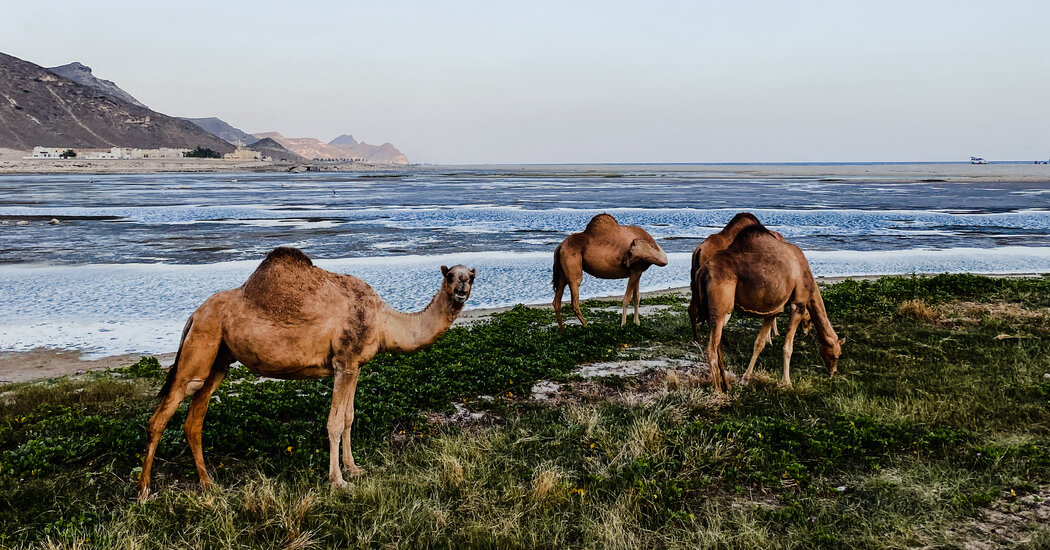
At Mughsail Beach, with Mount Qamar looming in the distance, the shallow pools of light green and blue water gathered in pockets in the sand, as dromedaries, or one-humped Arabian camels, walked along the shore, silhouetted by an orange sun. Ropes of a vine called goat’s foot crisscrossed the beach, with their pink flowers dotting the sand.

Just as the sun was fading into a fuzzy haze, a traditionally dressed couple walked barefoot along the shoreline, the man in a dishdasha (an ankle-length collarless tunic) and kuma (a rounded embroidered cap), and the woman in an abaya (a long black cloak) and hijab.

At the Khor Rori archaeological site, I met a man who looked to be in his mid-40s. We struck up a conversation, and when he found out I have Yemeni ancestry, he warmed to me. I sat with him through a few of his cigarettes.

He was fascinated by my Jewish heritage, saying I was the first Jew he had ever met and asking to take a photograph together. Then, as though he needed proof of my Jewishness, he asked that I write out several names in Hebrew, which I did. We exchanged numbers and planned to meet that evening for dinner.

After visiting Wadi Darbat, famous for its plateau of waterfalls, I drove to Mirbat, where my new friend had dropped a pin on my phone to share the exact location. He had ordered takeout, and we took the bags to the beach, where he laid out a mat and we sat eating cross-legged using our right hands in place of utensils, in the traditional manner. Having finished our meal of chicken biryani, we stepped out onto the rocks where the ocean lapped onto the stones. We went as far as we could without getting wet, finding a place to lean back comfortably. And then, as if old friends, we had a long talk about a range of topics, including religion, while staring up at the sky.

The next day, I stopped to have coffee in the bustling village of Sadah. As soon as I sat down, the neighborhood children playing at a nearby table were intrigued — likely with my unruly (and uncovered) hair, western (though modest) clothes and vaguely familiar features. The girls waved at me, while the boys made faces and loud jokes, clearly having a cheeky laugh at my expense. These exchanges are among my favorite moments on the road: no common language, no inherent gain for either party, just a bit of wonder on all sides, full of hand signals and carefree laughter.

A man in western clothes and his young daughter joined our interaction. He introduced himself as a native of Sadah and suggested a restaurant with the best view in town. Requesting that I refer to him as Ali, he later said he was a member of an elite military unit in Oman.

Ali proposed a drive to Natef Falls, where, as one local described, the “water comes from the mountains like tears.” I bathed in the freshwater, which felt noticeably distinct from mornings spent in the brine.

Drying off, I recalled the conversation we had shared earlier in the day. “I’m crazy, you’re crazy,” he’d said, as both of us laughed. What Ali had meant, restricted by the limits of our common language skills, was that I was a woman traveling by herself, an idea that to him was absolutely mad — and yet also brave. He was likening it to his métier: high-altitude military parachuting, which he knew was both courageous and a bit unhinged. (I’d seen videos of his jumps.)

In other words: This was Ali, paying me a compliment.

A couple days later I was off-roading in the Sugar Dunes of Al Khaluf in an attempt to reach Bar al Hikman before sunrise. Suddenly, my S.U.V. ceased moving forward; the wheels rotated in place, sending sand in all directions. The car sank into the white lumps. I tried in vain to dig myself out, but it was futile. I hesitated before calling Ali. Within 30 minutes of dropping him a pin, two friends from Ali’s unit pulled up — barefoot, wearing dishdashas and massars (embroidered headscarves) — in a beat-up ’90s truck the color of sand.

Ten minutes later, employing the practiced skill of people who had clearly done this many times before, they yanked my much larger vehicle out of its pit, and drove it back to the blacktop. They offered me a place to stay at their camp for the night, but I had taken up enough of their time. We said our goodbyes and, my hands pressed together in supplication uttering profuse shukrans (thank yous), they sent me on my way. Feeling inordinately lucky, I found an easily accessible nearby beach, splayed out in the trunk, and passed out.

The following morning, I walked across the stunning white sand beach, sat in the water feeling grateful for it all, and looked back at the dunes that had nearly devoured me the night before.

The farther north I traveled, the craggier the terrain became — stonier, less smooth. An hour north from the port city of Sur, I was enchanted by the many smaller coves that broke up the long stretch of beach near Bimmah Sinkhole. Weaving among them, I admired the massive chunks of brain coral and the way the morning sun reflected pastel highlights onto the stones.

Exactly two weeks into my trip, with only brief interludes from the intermittently unforgiving coastal terrain, I pulled into a parking spot on a perfectly manicured street — lined with elegant palms trees — in a swanky corner of Muscat, Oman’s capital, and walked my weary self into an international coffee chain.

Travel Trends That Will Define 2022


Card 1 of 7

Looking ahead. As governments across the world loosen coronavirus restrictions, the travel industry hopes this will be the year that travel comes roaring back. Here is what to expect:

Lodging. During the pandemic, many travelers discovered the privacy offered by rental residences. Hotels hope to compete again by offering stylish extended-stay properties, sustainable options, rooftop bars and co-working spaces.

Rental cars. Travelers can expect higher prices, and older cars with high mileage, since companies still haven’t been able to expand their fleets. Seeking an alternative? Car-sharing platforms might be a more affordable option.

Cruises. Despite a bumpy start to the year, thanks to Omicron’s surge, demand for cruises remains high. Luxury expedition voyages are particularly appealing right now, because they typically sail on smaller ships and steer away from crowded destinations.

Destinations. Cities are officially back: Travelers are eager to dive into the sights, bites and sounds of a metropolis like Paris or New York. For a more relaxing time, some resorts in the U.S. are pioneering an almost all-inclusive model that takes the guesswork out of planning a vacation.

Experiences. Travel options centered around sexual wellness (think couples retreats and beachfront sessions with intimacy coaches) are growing popular. Trips with an educational bent, meanwhile, are increasingly sought after by families with children.

Hoping to visit the Sultan Qaboos Grand Mosque, I missed the window for non-Muslim visitors. Instead, I walked through the surrounding gardens. Evening had fallen by the time I departed Muscat for Shinas, a coastal town near the border with U.A.E. I counted the gas flares that dotted the coastline as I continued my drive.

The following morning, I found a small unassuming cafe for breakfast. The corner shop, open on two sides, let in a much-appreciated breeze. I joined a morning crowd of South Asian workers, silently drinking their chais and munching their chapatis, transfixed by the overhead TV, a few flies resting on the plastic tables we all shared. I saw one of the men dip his chapati in his tea, and I did the same. Not half bad. After their meal, men would approach the sink in the middle of the shop and wash their hands and mouth, then use the thin waxy paper, provided by the shop, to dry themselves off. I followed suit.

These types of shops can be found all over the sultanate, a staple of communities in a country where foreign workers — mostly from Bangladesh, India and Pakistan — make up a significant portion of the population. (In Oman and many of its neighbors, the pandemic led to a reckoning about the many inequalities that exist in the Gulf states, which rely heavily on migrant labor.)

I was finally ready to head to Musandam, the northernmost of Oman’s 11 governorates, which borders the Strait of Hormuz and is separated from the rest of the country by a spit of Emirati land. Musandam has beautifully barren fjords hugging green-blue bays, jagged mountain ranges, and inlets that reveal small villages accessible only by boat. The port city of Khasab is a four-hour ferry ride from Shinas, north along the edge of the Arabian Peninsula and around the cape into the Strait of Hormuz.

I drove off the ferry into town and let curiosity lead me along the Khasab Coastal Road, gradually nearing my ultimate destination. The Musandam mountain scapes were intimidating, dwarfing the few homes that were built right up against them. One road appeared to turn into the mountains, and I decided to see where it led.

After about five minutes, the paved road gave way to dirt. I got out of the car to take some photos when I heard a man’s voice call and echo to me from across the valley. Looking in the direction of the sound, I discerned a figure waving me over. It turned out to be a group of young Omani men, who went on to invite me to join their breakfast, revealing a spread of coffee, karak, tanoor bread (baked in an underground clay oven), honey and cheese. The home, land, and surrounding flock of goats belonged to a family member, and they were all visiting from their respective homes in the nearby Emirates.

That afternoon, I made my way to the northernmost point of Oman — or as far as I could go without risking further off-roading high jinks — and gazed out over the coast. The waters were deceptively serene. I found a place to rest among the rocks and contemplated the historic nature of the sea passage. Only 21 miles wide at its narrowest point, the Strait of Hormuz has been essential for trade between civilizations for thousands of years.

Recently, some 20 percent of the global oil supply has flowed through the strait, which is the only way for oil tankers and cargo ships to reach the Indian Ocean for maritime trade. Tensions at this chokepoint have led (and continue to lead) to numerous conflicts.

Taking in the sea view from a small park just southwest of the horn, I waved to a group of women walking in the sand; they waved back. I longed for interactions with Omani women but had experienced very few throughout the journey — partly a result of my limited language skills and the solitary nature of my trip, and partly because of the complicated gender dynamics in a country with a spectrum of conservativeness.

I’d spoken briefly with a young doctor on the ferry to Masirah, on the deck reserved for families (the other side was reserved for single men), where we were both trying to get a good picture of the sunset and joked at our unsuccessful attempts. The conversation trailed off, and she returned to sit with her two friends.

At a generic food stand in Khasab, a group of young girls approached me, admiring my camera. I let them hold it and play, which drew the attention of some teenage girls who wanted to practice their English. “You’re cute!” they said to me, giggling.

Reflecting back on these fleeting moments, I was thankful to have had them.

I left Musandam the following morning and headed back to mainland Oman, where I booked a hotel in Muscat and, for the first night in weeks, slept in a bed. When I awoke, the city had flooded, limiting the options for my final day. I lay back down on the bed. I could still smell the smoke emanating from burned frankincense resin, could feel the air from Jabal Samhan on my skin, could hear the batting of green sea turtle flippers in the sand.

Noa Avishag Schnall, is a visual journalist based in Paris. You can follow her work on Instagram.



Source link

Previous Post

The Best Travel Bags for All Your Needs

Next Post

Medication Abortions Are Increasing: What They Are and Where Women Get Them

Anagha Salvi

Anagha Salvi

Associate Editor & Creative Director

Next Post
Medication Abortions Are Increasing: What They Are and Where Women Get Them

Medication Abortions Are Increasing: What They Are and Where Women Get Them

Leave a Reply

Your email address will not be published. Required fields are marked *

  • Trending
  • Comments
  • Latest
Who Is the Real China? Eileen Gu or the Chained Woman?

Who Is the Real China? Eileen Gu or the Chained Woman?

February 15, 2022
The Future of Female Entrepreneurs in Beauty Shines Bright—shark Tank India Has Proof

The Future of Female Entrepreneurs in Beauty Shines Bright—shark Tank India Has Proof

January 12, 2023
Shifting the Focus: Migration and Female Labour Force Participation

Shifting the Focus: Migration and Female Labour Force Participation

October 3, 2022
Recent global studies on digital equality highlight that digital transformation’s benefits across high, low and middle-income countries are not reaching most women

Digital transformations for gender equality

May 3, 2023
International Association of Sheet Metal, Air, Rail and Transportation Workers Helps Fund Pioneering Nonprofit’s Construction Camp For Girls

International Association of Sheet Metal, Air, Rail and Transportation Workers Helps Fund Pioneering Nonprofit’s Construction Camp For Girls

0
Marvel’s First Deaf Superhero: A First Step for Disabled Filmmakers

Marvel’s First Deaf Superhero: A First Step for Disabled Filmmakers

0
Working with the Taliban for Women’s Rights: It’s Like Speaking to Fish about Land!

Working with the Taliban for Women’s Rights: It’s Like Speaking to Fish about Land!

0

Announcing the Recipient of the Edie Windsor Champion for LGBTQAI+ Equality Award, 2021

0
TAGMA 2026 to Showcase Next-Gen Tooling Innovations at Die & Mould India Expo

TAGMA 2026 to Showcase Next-Gen Tooling Innovations at Die & Mould India Expo

March 30, 2026
Countdown To The Icc Women’s T20 World Cup 2026 Begins As Scoreboards Around The World Mark 100 Days To Go

Countdown To The Icc Women’s T20 World Cup 2026 Begins As Scoreboards Around The World Mark 100 Days To Go

March 5, 2026
Women’s Asia Cup Rising Stars 2026: Tanuja Kanwar Spins A Web Around Nepal As India A Qualifies For Semi-Finals

Women’s Asia Cup Rising Stars 2026: Tanuja Kanwar Spins A Web Around Nepal As India A Qualifies For Semi-Finals

February 18, 2026
India U17 Blank Bangladesh U19 To Win SAFF U19 Women’s Title

India U17 Blank Bangladesh U19 To Win SAFF U19 Women’s Title

February 10, 2026

Recent News

TAGMA 2026 to Showcase Next-Gen Tooling Innovations at Die & Mould India Expo

TAGMA 2026 to Showcase Next-Gen Tooling Innovations at Die & Mould India Expo

March 30, 2026
Countdown To The Icc Women’s T20 World Cup 2026 Begins As Scoreboards Around The World Mark 100 Days To Go

Countdown To The Icc Women’s T20 World Cup 2026 Begins As Scoreboards Around The World Mark 100 Days To Go

March 5, 2026
Women’s Asia Cup Rising Stars 2026: Tanuja Kanwar Spins A Web Around Nepal As India A Qualifies For Semi-Finals

Women’s Asia Cup Rising Stars 2026: Tanuja Kanwar Spins A Web Around Nepal As India A Qualifies For Semi-Finals

February 18, 2026
India U17 Blank Bangladesh U19 To Win SAFF U19 Women’s Title

India U17 Blank Bangladesh U19 To Win SAFF U19 Women’s Title

February 10, 2026

Welcome to our complete News Portal about Women India org, Lifestyle, News, and Articles. Take your time and immerse yourself in this amazing experience!

Facebook Youtube Twitter Linkedin Instagram Telegram

Women India Network

Women India Network
Beauty N Fitness India
Women India
Beauty N Fitness Times
Modern Fashion Life Style
Load More

TAGMA 2026 to Showcase Next-Gen Tooling Innovations at Die & Mould India Expo

TAGMA 2026 to Showcase Next-Gen Tooling Innovations at Die & Mould India Expo

by Anagha Salvi
March 30, 2026
0

Die & Mould India, the largest and most prestigious exhibition for the die and mould industry in India, is set...

© 2026 All Rights Reserved. Women India org

Powered By:Chrysolite Media Network Pvt. Ltd.

© 2025 All Rights Reserved. Women India org

No Result
View All Result
  • Home
  • About us
  • News
    • Lifestyle
      • Home & Decor
      • Travel & Leisure
      • Fashion & Style
      • Beauty & Skincare
      • Food & Recipes
    • Health & Wellness
      • Mental Health
      • Nutrition
      • Physical Fitness
      • Women’s Health
      • Yoga & Meditation
    • Career & Business
      • Career Advice
      • Investment
      • Leadership & Mentorship
      • Work-Life Balance
      • Women Entrepreneurs
      • Inspiration & Stories
    • Inspiration & Stories
      • Women Achievers
      • Change Makers
      • Grassroots Heroines
      • Interviews & Profiles
      • Celebrity Stories
    • Culture & Society
      • Women in Indian Culture
      • Social Change
      • Festivals & Traditions
      • Regional Spotlights
      • Religion & Spirituality
    • Events & Community
      • Women-Centric Events
      • Webinars & Workshops
      • Community Voices
      • Local Groups & Forums
      • Awards & Recognitions
  • Magazine
  • Women’s Rights
  • Entrepreneurs
  • Women and Girls
  • Exhibitions
  • Contact Us
  • Team

© 2026 All Rights Reserved. Women India org